
· Elena Marsh
Buckwheat Pillow for Back, Side and Stomach Sleepers: Loft by Position
Pillow pages sort products by fill and by shape. Almost none sort them by the variable that decides whether a pillow works for you: how tall it needs to be once you lie down on it. That height is not a property of the pillow. It belongs to your body in a given position, and changes the moment you roll over.
Why sleep position changes the height you need
Lie flat on a bare mattress and slide a hand behind your neck. The space your fingers fit into is what a pillow fills when you sleep on your back, and it is small, a couple of finger widths. Roll onto your side and try again between ear and mattress. That space is far bigger, because your shoulder now props your upper body off the surface and your head has to be lifted to match. Broad shoulders open a bigger gap than narrow ones, which is why two people can disagree about the same pillow without either being wrong.
Of time in bed spent on the side by 664 adults wearing accelerometers, against 37.5% on the back and 7.3% face down
Back sleepers: the smallest gap, and the easiest one to overfill
Back sleepers are the group most likely to be using too much pillow. The hollow behind the neck is shallow, so a full-size pillow stacked under the head pushes the chin toward the chest and holds it there for hours. The tell is rarely pain at night. It is waking with a compressed feeling at the front of the throat, or pulling the pillow out from under your head at 3am.
What back sleepers usually want is a low pillow with something firmer directly under the neck curve, so the head sits close to the mattress while the hollow underneath is still filled. That is why narrow, roll-shaped neck pillows exist as a category, and we cover that geometry in cylinder neck pillow.

Side sleepers: the widest gap, and the one most nights are spent in
Side sleeping needs the most fill of the three positions, and it is where people spend the largest share of the night, so getting it wrong costs the most hours. Too little height and the head drops toward the mattress, bending the neck sideways. Too much and it tips the other way. Both feel like nothing at lights out and like something by morning.
The advantage of loose fill here is that you are not choosing a height at checkout. You choose a volume of fill and push it where you want it. A molded contour cannot: it was set at the factory for an average shoulder. A 2025 study measured cervical spine shape on side sleepers across four pillow heights, and the height that best preserved the neck curve was not a fixed figure but one calculated from each subject's shoulder width.
Height band that gave side sleepers the cervical curve closest to natural standing in a 9-subject lab study, derived from each subject's shoulder width rather than offered as a fixed number
Stomach sleepers: how the cylinder behaves face down
Face-down sleeping already holds the head rotated to one side for hours, and height under the neck stacks extension on top of that rotation. The cylinder is built for the opposite job: it fills the gap under a head that stays roughly level, which is what back sleeping and side sleeping produce, and the loose hulls move by hand so you can match that gap down to the floor the memory foam layer sets. One thing worth knowing: most self-described stomach sleepers start face down and finish on their side, so judge a pillow on the position you spend the night in.
How to set your own loft
You will find plenty of those tables elsewhere, and they mostly trace back to nothing. A 2016 PeerJ study on pillow height and cervical alignment opens by stating that "there are no universal, evidence-based guidelines for pillow design or selection." That was ten subjects, supine only; the 2025 side-sleeper study used nine. Every figure we print carries a named source and a year, and a loft chart fails that test.
How to set your loft over three nights
Give a new pillow three nights before deciding anything: the fill arrives compressed from shipping and needs a day to settle back to height.
Night one, set the starting point. Lie in your usual position and have someone photograph you from the front, or prop a phone on the nightstand. You are checking whether the line of your neck continues the line of your spine, or breaks at the pillow. A mirror beside the bed works too.
Night two, correct in one direction only. If the head sat low, press hulls toward the centre to build height. If the chin was tucked, flatten the centre by pushing fill toward the ends. Change one thing, or you cannot tell what did what.
Night three, judge on the morning. A pillow that feels lovely at lights out and leaves you stiff at seven is too tall or too flat. One that feels slightly odd at first and unremarkable by morning is usually right.
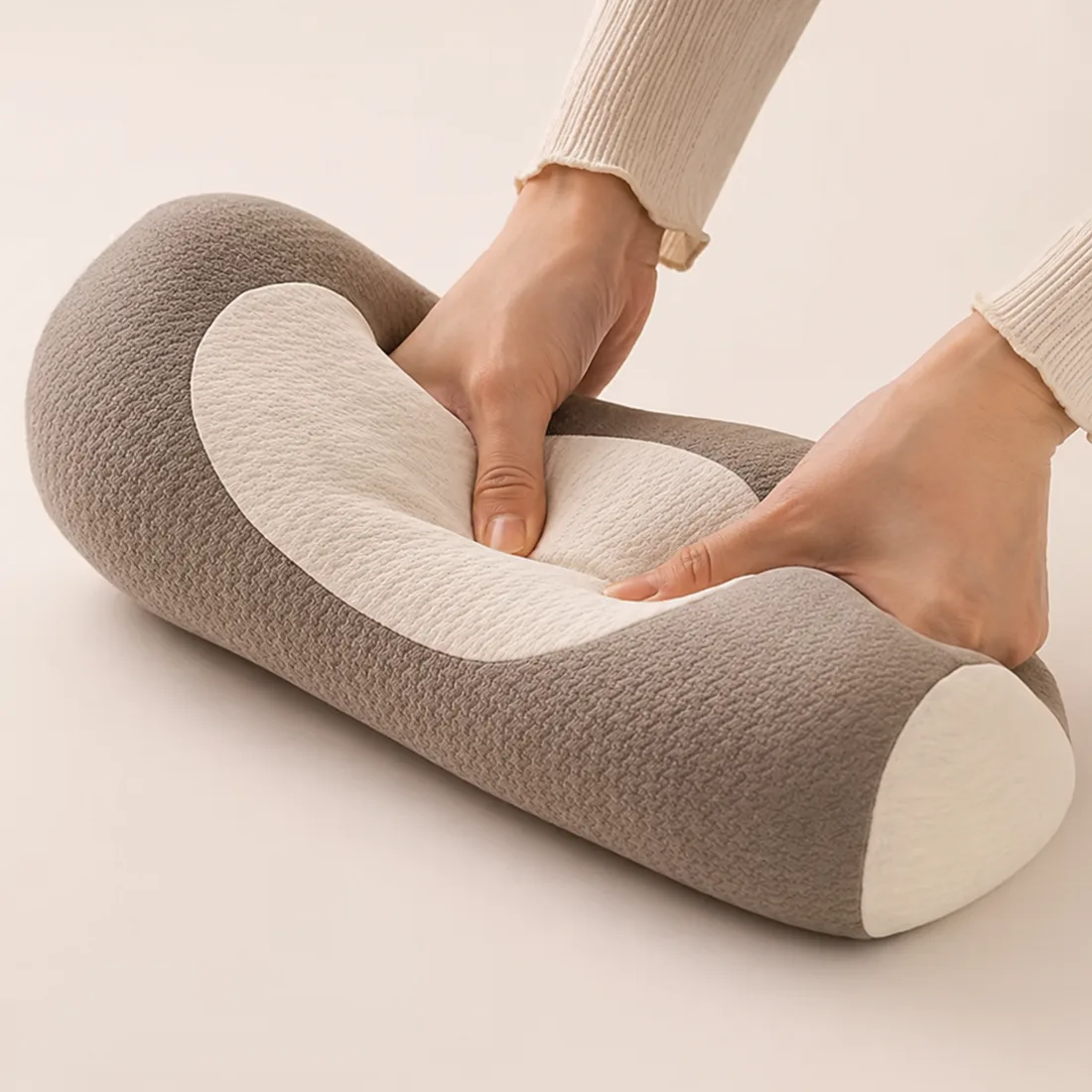
If the pillow still feels wrong after two or three weeks, the problem is more likely the shape or the fill type than the amount of fill. Our cervical pillow page compares adjustable fill with foam and latex.
What the HuskRest cylinder gives you, and what it does not
Our own pillow comes in one cylindrical, bone-shaped format. It is not a full-size pillow with adjustable loft, it is a narrow neck support used on its own or alongside your existing pillow. That distinction matters most for side sleepers: filling an ear-to-shoulder gap may take the cylinder plus a regular pillow under the head.
Dimensions of the HuskRest cylinder, sized to sit under the neck rather than to replace a full-width bed pillow
— HuskRest product measurements, 2026
The height adjusts downward by moving or removing hulls, but only so far: the memory foam layer inside sets a floor below which the cylinder will not flatten. If your reading of this article is that you need something genuinely low, that floor is better known before you order. For what the hull fill contributes independently of height, see buckwheat pillow benefits and our buckwheat hull pillow page.
Verified reviews: 83 reviews, 4.7 / 5, on our reviews page.
When loft is not the problem
Everything above assumes an ordinary comfort question. If you wake with pain that is severe, persistent, or spreading into an arm or hand, it is worth speaking to a doctor or a physical therapist alongside setting up your pillow, and we cover that in buckwheat pillow for neck pain.
Otherwise, a pillow you can reshape is a low-risk test. Orders ship free within 6 to 10 business days with a 30-day money-back guarantee. Specifications and pricing are on the buckwheat pillow homepage.
Frequently asked questions
Is a buckwheat pillow good for side sleepers?
Side sleeping opens the widest gap between head and mattress, roughly ear to shoulder, so it needs the most fill of the three positions. Loose fill suits that well: you pack hulls toward the contact point rather than buy a taller pillow.
How high should my pillow be if I sleep on my back?
There is no single correct figure, and anyone printing one is guessing. On your back you are only filling the hollow behind the neck, so back sleepers usually need less height than they expect. The test is whether your chin ends up level rather than tucked toward the chest.
Can I use a buckwheat pillow if I sleep on my stomach?
Face-down sleeping already turns the head to one side, and height under the neck adds to that rotation. This cylinder is shaped to fill the gap under a head that stays roughly level, which is what back sleeping and side sleeping produce, and the loose hulls move by hand to match that gap. Most self-described stomach sleepers start face down and finish on their side, so set the loft for the position you spend the night in.

Elena Marsh · Sleep Product Reviewer, 5 yrs testing pillows and sleep accessories
Elena has spent five years hands-on testing pillows and sleep accessories, evaluating fill materials, support claims, and real-world durability rather than marketing copy.
Reviewed by Elena Marsh. This article is informational and does not constitute medical advice. See our testing methodology.