
· Elena Marsh
How Long Does a Buckwheat Pillow Last? What Changes Over the Years
Most pillow-lifespan advice is written for materials that die on a schedule. Foam and fiber fills compress, stop springing back, and at some point the whole pillow goes in the bin. Hull fill does not work like that. What follows is what actually changes inside a buckwheat pillow over long use, how to read those changes, and the habits that decide whether the fill ages well or badly.
A hull pillow runs on two clocks, not one
This is the structural difference that makes the lifespan question awkward to answer in months. On a down or polyester pillow, the fill and the object share a fate, when the fill flattens the pillow is finished. On a hull pillow the cover is doing the work of being touched, slept on and laundered, while the fill sits underneath in a much gentler environment. Those two parts age at completely different speeds, and they fail in completely different ways.
It also changes what "wearing out" looks like. A foam pillow tells you it is done by feeling flat under your head. Hull fill almost never gives you that signal, because rigid husks do not have foam's compression-fatigue failure mode, a point we go through in buckwheat pillow benefits. It tells you in smaller, easier-to-miss ways instead.
What actually changes inside the fill
Three things happen to hull fill over long use, and none of them is dramatic.
The fill settles. New hulls sit loosely with a lot of air between them. Under nightly load they pack down into a tighter arrangement, the air gaps shrink, and the same quantity of fill occupies slightly less space than it did. The pillow has not lost anything, it has become denser. This is the change people most often mistake for the pillow going flat, and it is also the one most easily undone by hand.
Individual hulls crack. A husk is rigid, and rigid things eventually fracture under repeated load. Broken hulls do not vanish, they become smaller fragments, and the finest of those work their way down through the fill and gather at the bottom of the cover. That is the grit people find when they open a long-serving pillow, and it is ordinary attrition rather than a sign of anything wrong.
The sound shifts. Hull fill rustles because the pieces move against each other, so settled fill carrying a share of smaller fragments sounds slightly finer than a new one. Worth separating from the first-week effect, though: most "it got quieter" reports are habituation, not the pillow changing.

The signs your fill is asking for a top-up
| What you notice | What it means | What actually helps |
|---|---|---|
| Sits lower than it used to, at the same setting | Fill has packed tighter over months of load | Reshape by hand first; add fill only if that no longer restores the height |
| Fine grit at the bottom when you open the cover | Fragments from hulls that cracked under normal use | Shake or tip it out, then top the fill back up |
| Fill has migrated to one end | Gravity plus nightly repositioning | Roll and redistribute by hand, no fill needed |
| Rustle sounds finer than you remember | Smaller fragments and denser packing | Nothing, unless loft dropped with it |
The migration line matters more on a cylinder than on a flat pillow, because a narrow shape concentrates the fill and gives it somewhere to run to. We cover that geometry in cylinder neck pillow. In practice, rolling the pillow between both hands from time to time handles it before it becomes noticeable at night.
Airing is the habit that does most of the work
A pillow spends roughly a third of every day under a warm head, a slow, steady input of humidity into a natural fill. That is only a problem when the moisture cannot leave again. Airing is simply giving it the chance to leave: unzip the cover, put the fill somewhere dry and ventilated with air moving around it, and let it sit for a few hours before reassembling.
Nightly sleep recommended for most adults, which is how long a pillow's fill spends under a warm head every single night
— CDC, Sleep and Sleep Disorders guidance, 2024
A dry, sunny spot by a window is the easy version of this, and the season is worth planning around. The months when a bedroom is warmest and least ventilated, windows shut, heating on, are exactly the months when airing matters most and outdoor drying is least practical, so pick the dry days rather than waiting for summer. The cover itself goes a different route, it comes off and washes, and the full routine for that is on our buckwheat hull pillow page rather than repeated here.
Topping up instead of starting over
The reason lifespan looks different for this fill is that the maintenance model is different. Buckwheat pillows are generally kept going by refreshing the fill periodically over years of regular use rather than by replacing the pillow, which is an option foam simply does not offer, and we set out the reasoning behind that in buckwheat pillow benefits.
Practically, adding fill follows the same rule as setting height in the first place: gradually, judged over nights rather than minutes. Add a handful, sleep on it, then decide. Adding a lot at once overshoots, and you take it back out having learned nothing. The three-night method we use for setting loft works just as well for topping up, and it is laid out step by step in buckwheat pillow for back and side sleepers.
The reverse case is worth planning for too. If you take hulls out to lower the pillow, keep them. Sealed in a dry bag they stay perfectly usable, and they are the easiest fill you will ever source when you want that height back, whether that is a change of mattress, a change of sleeping position, or simply changing your mind after two weeks.
What shortens a hull pillow's life fastest
Almost everything on this list comes back to water.
- Soaking or machine-washing the fill. The single fastest way to ruin hulls. Water gets into a material that has no way of drying from the inside out, and mildew follows. The cover is washable, the fill is not.
- Damp storage. A spare pillow kept in a basement, a garage or an unheated cupboard absorbs ambient moisture over months without anybody touching it.
- Sealed plastic containers. Counter-intuitive, but a sealed bin traps humidity against the fill instead of keeping it out. A breathable fabric bag keeps dust and pests off while still letting the fill breathe.
- Sleeping on bare fill. Without a cover between skin and hulls, oils and perspiration go straight into a material you cannot wash. The cover is the sacrificial layer, and using one is what lets the fill stay clean for years.
Hull fill is not fragile, it is just specific. Keep water out of it and none of the above ever starts.

What the HuskRest cylinder gives you here
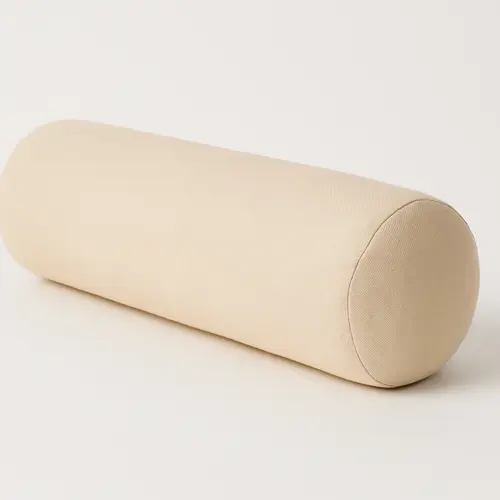
Our own pillow is built around this maintenance model. The fill is buckwheat hulls alongside a memory foam layer inside a cylindrical, bone-shaped cover, and the fill is reachable through the cover's opening, which is what makes reshaping and topping up possible at all. The cover is a 100 TC, density-20 polyester-cotton blend that unzips and washes, so the part that takes the daily contact is also the part you can actually clean.
Dimensions of the HuskRest cylinder, one shape and one size, in two colorways
— HuskRest product specification, 2026
One limit worth knowing: the memory foam layer sets a floor, so the cylinder lowers only so far however many hulls you remove. That keeps a baseline structure under the hull fill. If natural-material questions are what brought you to this fill, our organic buckwheat pillow page covers what that does and does not mean here.
Verified reviews: 83 reviews
— HuskRest verified buyer reviews, 2026
Everything above describes how the hull material itself behaves over time, drawn from the properties of the fill rather than from any single buyer's account.
One boundary worth keeping separate: everything here is about maintaining a pillow, not about health. If you are dealing with neck pain that is severe, persistent, or spreading into an arm or hand, fill maintenance is not the variable to work on, and we treat that line carefully in buckwheat pillow for neck pain.
Full specifications and pricing sit on the buckwheat pillow homepage. Orders ship free within 6 to 10 business days and carry a 30-day money-back guarantee.
Frequently asked questions
How long does a buckwheat pillow last?
Hull fill does not fail on a schedule the way foam does, so there is no single figure. Buckwheat pillows are generally kept on a top-up model rather than a replacement model: the hull fill is refreshed periodically over years of regular use while the pillow itself stays in service. Kept dry, the fill is the part that ages slowest.
Do buckwheat hulls turn to dust over time?
Not the whole fill, but individual hulls do crack under years of nightly load and shed fine fragments, which collect at the bottom of the cover. Finding a little grit when you unzip a pillow that has seen long use is normal attrition, not a defect. Shake it out and top the fill back up.
Does the rustling get quieter the longer you use it?
Most people report noticing it less over the first nights, which is habituation rather than the pillow changing. Over much longer periods the sound itself does shift slightly, since settled fill and smaller fragments move against each other differently than a loose, new fill does.
How do I know when to add more hulls?
Loft is the signal, not the calendar. If the pillow sits noticeably lower under your neck than it used to at the same setting, and redistributing the fill by hand no longer brings the height back, that is the point where adding fill does something. Add it gradually and judge it over a few nights.

Elena Marsh · Sleep Product Reviewer, 5 yrs testing pillows and sleep accessories
Elena has spent five years hands-on testing pillows and sleep accessories, evaluating fill materials, support claims, and real-world durability rather than marketing copy.
Reviewed by Elena Marsh. This article is informational and does not constitute medical advice. See our testing methodology.